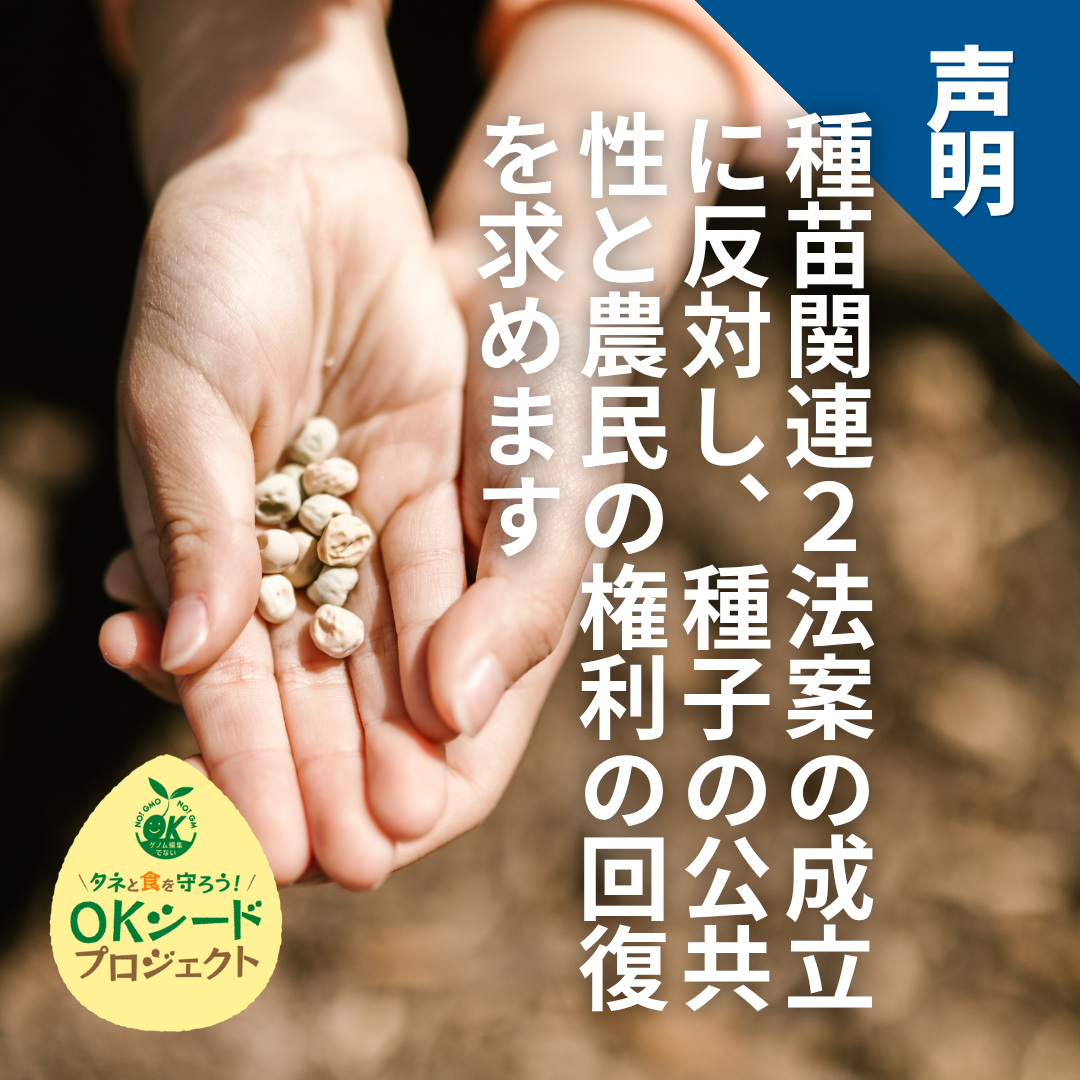
そこでOKシードプロジェクトとして、この問題に関する声明を発して、広く、この問題を訴え、この2法案を拙速に審議せず、農民、市民を巻き込む形で、今後の日本のタネのあり方を議論していくことを求めるものです。
- 2法案が抱える極めて重大な7つの問題点
- 私たちは以下を求めます
- 参考資料
- Statement Against the Two Seed-Related Bills in Japan: A Call to Restore the Seed Commons and Farmers’ Rights
- Concerning the Two Seed-Related Bills Currently Before the Diet
- Seven Critical Threats Posed by These Bills
- 1. Abnormal Extension of Monopoly Duration (35-40 Years) (PVP Act Revision)
- 2. Pre-emptive Injunctions at the “Application Stage” (PVP Act Revision)
- 3. “Presumption by Characteristics” and the Surveillance Regime (PVP Act Revision)
- 4. Privatization of Public Assets and Infrastructure (New Seedling Promotion Act)
- 5. Hasty Expansion of New Genomic Technologies and the Risk of Losing Traditional Breeding Techniques (New Seedling Promotion Act)
- 6. Global Exploitation via “Strategic Overseas Licensing” (PVP Act Revision)
- 7. Complete Disregard for “Farmers’ Rights” (Both Bills)
- We demand the following:
2法案が抱える極めて重大な7つの問題点
1. 異常な独占期間の延長(35年・40年)(種苗法改正案)
育成者権の存続期間を、現行の25年から35年(樹木40年)へと延長します。これはUPOV条約の最低基準(20年)を著しく超え、特許法(20年)すら凌駕します。このような長期間の保護を設定している国は世界のどこにもありません。知的財産権の極端な強化は種子の独占をもたらすことで、農民の権利が奪われるだけでなく、新品種の開発を妨げ、健全な種苗企業の発展を妨げます。
2. 輸出を目的とした「出願段階」からの差止請求権の新設(種苗法改正案)
品種登録が完了する前の「出願中」であっても、輸出を目的とする行為に対して、企業が農家に対し栽培停止や作物の廃棄を命じることができる権利が新設されます。対象が輸出に限定されているとはいえ、企業側の主張のみで出願段階から重いペナルティの脅威に晒される仕組みは、海外展開を見据える農家や流通業者に過度な負担と法的リスクを強い、さらなる萎縮を生むことになります 。
3. 既存の「名称による推定」による萎縮と監視体制強化による悪影響(両法案の相乗効果)
これまで育成者権者側にあった種苗法違反の立証責任が、2020年の種苗法改正で農家側に転換する規定が導入されています(第35条3項)。今回の法改正で、独占期間が35年・40年へと延長されることで、農家はこの「推定」の脅威に長期間にわたり晒され、今回の新育苗法案によって「重要品種」の登録が国策として大量に推進されることによって、たまたま似た名称で在来種を扱っていただけの農家までもが、かつてない規模で過度な萎縮に追い込まれる恐れがあります。
4. 公的資産とインフラの私物化(新育苗法案)
国の方針に沿って民間企業が重要品種育成事業計画を提出し、承認されると、国立研究開発法人(農研機構)の保有する研究施設や設備が、民間企業の品種開発のために供用される仕組みが法制化されています 。地方自治体もこの国の方針に沿った連携を求められます。これまでの日本の種苗の中軸を担ってきた地方自治体の公的種苗事業は民間企業のインフラとして使われる可能性があります。公的資産を利用して開発された品種は公的な財産になるはずですが、産業技術力強化法によって、これを民間企業の独占物にすることが可能になっています。これは「コストは税金と自治体、利益は企業」という公的資産の私物化に他なりません。
5. 新ゲノム技術の利用の性急な拡大と従来の品種改良技術の喪失の怖れ(新育苗法案)
法案制定の理由とされる気候変動対策には、種苗の多様性を確保することが有効ですが、この法案では逆に広域向けの品種を少数作ることになることが想定され、法案制定理由と整合性がありません。
国家がトップダウンで目標を設定して運用されるこの新たな育種体制では、全国各地の地域のニーズに応じた多様な品種の開発は置き去りとなり、広域を対象に、より売り上げを得られる品種を効率的に開発することが求められます。それはゲノム編集や重イオンビームなどを使った人為的突然変異に依存するか、育種ビッグデータに頼ったAI育種が幅を利かせることになる可能性があります。しかし、そうした品種が激変しつつある環境に対応でき、健康にも安全なものとなるという保証はありません。
さらに、国家主導の新たな種苗開発体制に実質的に参加できるのは特定の少数民間企業に限られ、種苗の独占がさらに強められ、地域の農業に貢献してきた小さな地域の種苗企業が姿を消す可能性があります。
また、これまで日本の種苗開発の主軸となってきた公的種苗事業は地方自治体が主軸になり、日本を代表する地域に適した品種が数多く開発されてきました。民間企業開発支援体制が大きくなることで、地域向け品種が失われるだけでなく、日本が世界的に誇ってきた従来の品種改良技術が失われてしまう可能性があります。
6.「戦略的海外ライセンス」によるグローバルな農民の権利の喪失の怖れ(種苗法改正案)
「戦略的海外ライセンス」の名の下に、海外での日本の知財管理を強化するものです。これは日本のブランドを守るという名目ですが、実態は「商標権」と「育成者権」を組み合わせて、国内外の農家から重層的にロイヤリティを吸い上げる体制となり、結局、ごく一部の企業は儲かるけれども農家は厳しいグローバルな競争に曝されることになります。
また、海外にも国内と同様の体制を引くために、日本政府は東アジア植物品種保護フォーラムなどを通じて、特にアジア諸国政府にUPOV1991への加入と日本と同様の種苗法改正を行うことを求めており、タネの権利を脅かされるのは国内の農家のみに留まらず、アジアの農家からは反対の声が上がっています。農家は国際的に過酷な競争を余儀なくされ、儲かるのは巨大企業ばかりで、個々の農家の収入には直結しません。
7.「農民の権利」の完全な黙殺(2法案両方)
国連の「小農と農村で働く人びとの権利に関する国連宣言」や食料・農業植物遺伝資源に関する国際条約(ITPGRFA)などが認める農民の権利について、本法案は一切の配慮を欠いています。農家が数千年かけて築いてきたタネの仕組みは「コア・シードシステム」として守るべきであり、現に、インド、イタリア、ブラジル、フィリピンなどでは国レベルの法律で農民の権利や在来種が明記・保護されており、韓国でも地方自治体の条例による在来種の保全と活用が力強く広がり、農民による種子のシステムが強化されています。ところが日本の種苗政策はこれを一切無視して、農業の根幹をなす活動である育種・採種活動を実質的に不可能にしてしまうものであり、日本の農業の真の発展を阻害するものです。そして、そのような法改正の影響は海外にも及ぶ可能性が懸念されます。
私たちは以下を求めます
- 種苗法再改正案および新育苗法案の拙速な審議に反対します。
- 独占期間の35年延長を撤回し、国際標準(20年)以下に据え置くことを求めます。
- 農家の自家採種および在来種の保存と活用を法的に守り、支援することを求めます。
- 地方自治体の公的種苗事業が持つ意義を再確認し、地域の特性に合った種子の生産継続を求めます。
- 東アジア植物品種保護フォーラムなどを通じたアジア諸国へのUPOV1991への加入、種苗法改正の政治的圧力を加えることをやめることを求めます。
タネは過去から未来への贈り物であり、全人類の共有財産です。過剰な知的財産権の中に閉じ込めてしまえば、自由な育種も困難となり、むしろ育種産業セクターは健全な活気を失います。私たちは、この「命の根源」を過剰な国家的な枠組みに閉じ込めることに反対し、持続可能な農業を次世代へ引き継ぐために、この5項目を強く求めます。
OKシードプロジェクト
参考資料
Statement Against the Two Seed-Related Bills in Japan: A Call to Restore the Seed Commons and Farmers’ Rights
Concerning the Two Seed-Related Bills Currently Before the Diet
The Japanese Cabinet has approved the revision of the “Plant Variety Protection Act (PVP Act)” and the “Act on the Promotion of Breeding and Seedling Production of Important Varieties” (commonly known as the Climate Change Adaptive Variety Act). The stated reasons for these bills are that adapting to climate change and strengthening intellectual property rights (IPR) over seeds are essential to bolster Japanese agriculture. However, we must conclude that these two bills will gut the public seed programs centered on local governments—which have historically been the pillar of Japan’s seed supply—and pave the way for a corporate monopoly over seeds.
Seven Critical Threats Posed by These Bills
1. Abnormal Extension of Monopoly Duration (35-40 Years) (PVP Act Revision)
The bill extends the duration of breeder’s rights from the current 25 years to 35 years (40 years for trees). This far exceeds the UPOV Convention’s minimum standard (20 years) and even surpasses standard patent protection periods (20 years). No other country in the world grants such prolonged protection. An extreme strengthening of IPR not only strips farmers of their rights and causes seed monopolies, but it also hinders the development of new varieties and stifles the healthy growth of the seed industry itself.
2. Pre-emptive Injunctions at the “Application Stage” (PVP Act Revision)
The revision introduces a draconian right allowing companies to demand the suspension of cultivation and the destruction of crops while a variety is still merely “under application” (before registration is granted). By simply claiming a crop “looks similar,” companies can paralyze farmers with legal risks, creating a chilling effect that will discourage even the cultivation of traditional and public varieties.
3. “Presumption by Characteristics” and the Surveillance Regime (PVP Act Revision)
The law weaponizes digital trait matching, allowing authorities to presume infringement without conducting actual field comparisons. By granting greater authority to state-funded investigative units (so-called “Variety Protection G-Men”) and IP management agencies, the legitimate practice of saving seeds of traditional varieties may be severely compromised due to intimidation and chilling effects.
4. Privatization of Public Assets and Infrastructure (New Seedling Promotion Act)
Under the new regime, if private companies submit a “Business Plan for Breeding Important Varieties” in line with government policy and it is approved, local publicly funded agricultural experiment stations are mandated to cooperate with the corporate breeding and multiplication programs. The public seed programs of local municipalities, which have been the backbone of Japan’s seed supply, will be repurposed as infrastructure for private corporations. Although varieties developed using public assets should remain public property, the Industrial Competitiveness Enhancement Act allows them to be monopolized by private companies. This is a blatant privatization of public assets: the costs are socialized (borne by taxpayers and municipalities), while the profits are privatized.
5. Hasty Expansion of New Genomic Technologies and the Risk of Losing Traditional Breeding Techniques (New Seedling Promotion Act)
Under this top-down breeding regime dictated by the state, the development of diverse varieties suited to regional needs will be abandoned in favor of the efficient development of highly profitable varieties for broad distribution. This approach may heavily rely on artificial mutations using genome editing and heavy-ion beams, or AI-driven breeding based on big data. However, there is no guarantee that such varieties can adapt to rapidly changing environmental conditions or are safe for human health. Furthermore, participation in this state-led breeding regime is limited to a select few private corporations. This will intensify seed monopolies, drive small regional seed companies out of business, and risk the loss of Japan’s world-renowned traditional breeding techniques.
6. Global Exploitation via “Strategic Overseas Licensing” (PVP Act Revision)
Under the name of “Strategic Overseas Licensing,” the revision aims to strengthen Japan’s intellectual property management abroad. While framed as protecting Japanese agricultural brands, the reality is a system combining trademark and breeder’s rights to extract multi-layered royalties from farmers both domestically and internationally. Ultimately, only a very few corporations will profit, while farmers will be left exposed to severe global competition.
Furthermore, to impose this same regime overseas, the Japanese government has been using platforms like the East Asia Plant Variety Protection Forum (EAPVP Forum) to press Asian governments into joining UPOV 1991 and amending their national seed laws to mirror Japan’s. Thus, the threat to seed rights extends far beyond our domestic farmers, and voices of strong opposition are already rising from farmers across Asia. Farmers are forced into a brutal international competition that enriches only giant corporations, doing nothing to directly benefit the incomes of individual farmers.
7. Complete Disregard for “Farmers’ Rights” (Both Bills)
The bills completely ignore the rights of farmers explicitly recognized by the UN Declaration on the Rights of Peasants and Other People Working in Rural Areas (UNDROP) and the International Treaty on Plant Genetic Resources for Food and Agriculture (ITPGRFA). The seed systems built by farmers over millennia must be protected as the “Core Seed System.” In fact, countries like India, Italy, Brazil, and the Philippines protect farmers’ rights and traditional varieties through national legislation, and the conservation and utilization of traditional varieties are expanding vigorously through local ordinances in South Korea, strengthening farmers’ seed systems. Japan’s policy ignores all of this, practically outlawing the essential agricultural practices of breeding and seed saving, and sabotaging the true development of Japanese agriculture. Furthermore, there is grave concern that the detrimental impacts of these extreme domestic legal revisions will ultimately spill over and affect farmers overseas.
We demand the following:
- We oppose the hasty legislative deliberation of the PVP Act revision and the new Seedling Promotion Act.
- We demand the withdrawal of the 35-year monopoly extension, keeping protection limits in line with the international standard (20 years).
- We demand the legal protection and active support for farmers’ rights to save seeds and to conserve and utilize traditional varieties.
- We demand the defense of the independence of local agricultural experiment stations and the rebuilding of a robust, public seed supply system.
- We demand an immediate end to the political pressure exerted on Asian countries through the EAPVP Forum to force them into joining UPOV 1991 and revising their national seed laws.
Seeds are a gift from the past and a legacy for the future; they are the shared heritage of all humanity. Locking them inside an excessive intellectual property framework makes free breeding difficult and stifles the vitality of the breeding sector itself. We oppose trapping this “source of life” within an overreaching state and corporate framework, and we strongly demand these five points to pass down sustainable agriculture to the next generation.
OK Seed Project